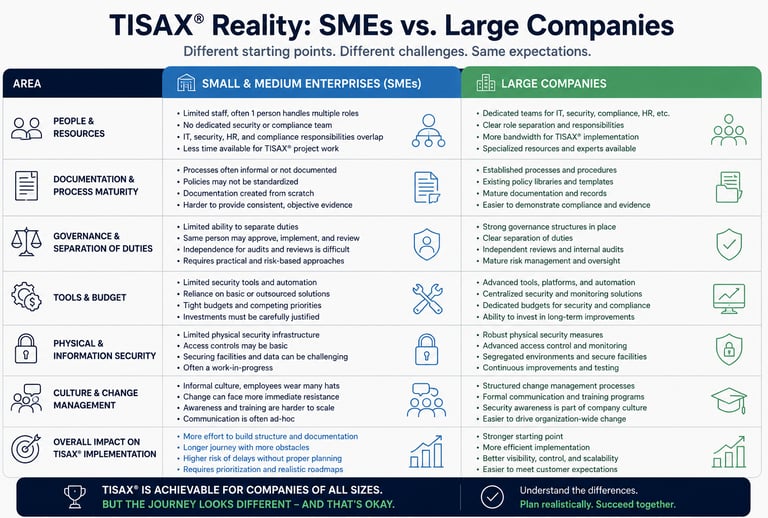
TISAX® Reality: Why SMEs Face Different Challenges Than Large Companies
TISAX® implementation can look very different depending on company size. This article explores the operational, organizational, and resource-related challenges small and mid-sized companies often face during TISAX® projects compared to large automotive enterprises, and why understanding those differences is critical for realistic and successful implementation.
TISAX® Reality: SMEs vs. Large Companies
One topic that is rarely discussed openly in the TISAX® world is this:
TISAX® implementation often looks completely different for small and mid-sized companies compared to large automotive enterprises.
And honestly, this matters!
Many SMEs begin their TISAX® journey by comparing themselves to major suppliers or global manufacturers with large security teams, mature governance structures, and established compliance departments. Very quickly, they start feeling behind.
But in many cases, they are not behind at all, they are simply operating under a completely different reality.
The Starting Point Is Not the Same
Large automotive organizations often already have:
dedicated IT teams
internal auditors
compliance departments
legal teams
HR structures
mature documentation systems
formal governance processes
cybersecurity budgets
established risk management programs
Some may already operate under ISO 27001
or similar management systems before TISAX® even becomes a requirement.
Now compare that to many smaller suppliers.
A smaller company may have:
one IT administrator
outsourced MSP support
no dedicated compliance role
limited internal documentation
informal processes
employees wearing multiple hats
little time available for project work
Yet the customer expectation may still sound exactly the same: “You need TISAX®.”
This is where many SMEs begin to feel overwhelmed.
TISAX® Is Not Necessarily Harder Technically
This is important to understand, in many small organizations, good security practices may already exist.
Employees may know their responsibilities
Systems may already be protected
Sensitive information may already be handled carefully.
The challenge is often not the technical side alone, the challenge is operational maturity and formalization.
TISAX® requires organizations to:
document processes
demonstrate consistency
assign accountability
collect objective evidence
formalize responsibilities
manage risk systematically
That transition can be much more difficult for smaller organizations because many activities are handled informally.
The One-Person Problem
One of the biggest realities inside SMEs is role overlap.
In large organizations, responsibilities are usually distributed:
IT handles infrastructure
HR manages onboarding
compliance manages governance
internal auditors perform reviews
physical security manages access controls
In smaller companies, one individual may be handling multiple responsibilities simultaneously.
The same person may:
manage IT
write policies
coordinate vendors
collect evidence
support onboarding
handle cybersecurity incidents
coordinate the TISAX® assessment
That creates both workload pressure and governance challenges, especially when it comes to independence and separation of duties.
Documentation Is Often the Biggest Gap
Many SMEs operate efficiently without extensive documentation.
Processes may exist and function well operationally, but they may not be:
standardized
formally approved
consistently reviewed
measured
tracked through records
This becomes difficult during a TISAX® assessment because assessors require objective evidence.
The issue is often not: “We are insecure.”
The issue is: “We never documented how we do things.”
That is a very different problem.
Separation of Duties Becomes Difficult
Another challenge for smaller organizations is governance structure.
Certain activities ideally should involve independent review or approval.
Examples include:
access approvals
internal audits
policy reviews
administrative oversight
risk acceptance
Large companies often have enough personnel to separate these responsibilities naturally, SMEs frequently do not.
That does not automatically mean failure, but it does require practical and risk-based approaches to implementation.
Budget and Resource Constraints
Large enterprises may dedicate:
project managers
security engineers
compliance officers
consultants
governance teams
to a TISAX® initiative, most SMEs cannot. For many smaller suppliers, TISAX® work happens alongside daily operational responsibilities.
Which means:
Timelines may move slower
Prioritization becomes critical
Scope decisions become extremely important
Implementation must be realistic
This is one reason why smaller organizations benefit heavily from structured planning early in the project.
Physical Security Challenges
Physical security expectations can also create pressure for SMEs, especially when handling:
prototypes
customer information
engineering environments
testing facilities
Large organizations may already have:
badge systems
surveillance infrastructure
restricted zones
visitor management systems
security personnel
Smaller companies may still be building those capabilities. Again, the challenge is often maturity and structure rather than intent.
Culture and Change Management
Smaller companies usually operate faster and more informally, because:
Communication is direct
Employees know each other closely
Processes evolve organically
When TISAX® introduces:
formal approvals
documented procedures
stricter access management
awareness requirements
evidence collection
governance expectations
the organizational shift becomes noticeable very quickly.
That adjustment period is normal.
TISAX® Is Still Achievable for SMEs
This is the most important point: TISAX® is absolutely achievable for small and mid-sized organizations!
In fact, many SMEs successfully complete TISAX® assessments every year.
But the implementation path often looks very different from what it does inside large automotive enterprises.
That reality deserves more open discussion because many smaller suppliers incorrectly assume they are failing when they are actually facing normal SME-related implementation challenges.
The key is not trying to operate like a multinational corporation overnight.
The key is:
realistic scoping
proper prioritization
practical governance
gradual maturity improvement
consistent implementation
Understanding the difference between SME realities and enterprise realities is often the first major step toward a successful TISAX® journey.
Continue the Work
If you are reviewing operations security, you are often dealing with broader questions around ownership, resources, tooling, and internal priorities.
For organizations still aligning leadership, scope, and budget before deeper implementation, there is a structured TISAX® Starter Kit available.
It is designed to support executive-level planning and readiness discussions.
More details here:
https://payhip.com/b/CQSlY
If you are already in that phase, feel free to reach out directly.